

Last month I wrote about keeping your photo simple—isolating the subject and avoiding distractions. But there’s much more to composition, many more ways to make your photos terrific. Here are a few tips and suggestions you may find helpful. (more…)

Last month I wrote about keeping your photo simple—isolating the subject and avoiding distractions. But there’s much more to composition, many more ways to make your photos terrific. Here are a few tips and suggestions you may find helpful. (more…)
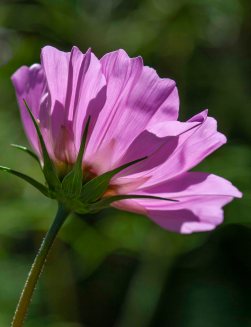 Do you enjoy big flowers with bright, showy colors and carefree maintenance? It’s hard to beat annuals for season-long impact. Whenever I think of annuals, I immediately think of cosmos, one of the very best annuals for Colorado gardens.
There are currently thought to be 36 species in the genus Cosmos, but the two most often grown in our gardens are C. bipinnatus (left) and C. sulphureus. (There are two other Cosmos species in cultivation. One is a frost-tender, tuberous perennial known as Chocolate Cosmos, C. atrosanguineus. The other is Cosmos parviflorus, a wildflower of the western United States.)
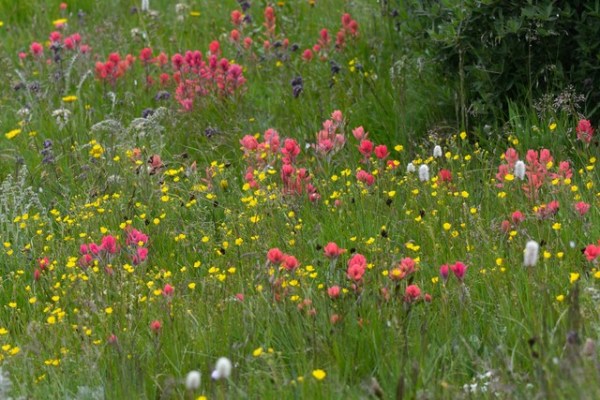
Nature is an excellent gardener. Take a walk through any pristine boonies and you’ll be amazed at the beauty of what grows untended. I’d never consider combining flowers in shades of fuchsia, orange, yellow, and blue, but when nature does it, we stand in awe. Ferns tucked alongside waterfalls, acres of wildflowers, pink Oxalis carpeting the ground under towering redwoods—it’s all stunning.


It’s helpful to understand your equipment, to know how to set up your camera so your subject will be in focus and properly exposed. Knowing how everything works will allow you to avoid mistakes and the frustration that accompanies them. If you’re especially enamored of technical things, you’ll probably enjoy trying out all your camera’s menu choices, dials, and buttons, learning what it’s capable of. But just as most of us don’t pull out our phone simply to play with the settings, understanding the technical aspect of photography isn’t our final goal. Rather, it’s the means to an end. We want to create quality photographs.

How would you like a perennial that is hardy from USDA zones 3 through 9, tolerates browsing deer, drought, and smog, while attracting butterflies with its brilliant flowers? Moss phlox (Phlox subulata, also known as moss pinks and creeping phlox, does all that, and more. A very low growing groundcover that barely reaches six inches in height, moss phlox spreads to a diameter of two feet, making it ideal for the front of a border. The leaves resemble short, prickly pine needles, and are a gray-green in color. But it’s the flowers that cause me to run to the garden center for more.
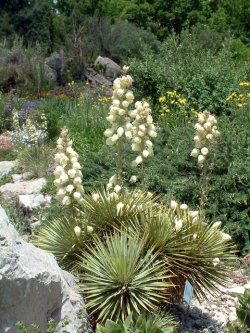 Yuccas are as much a part of the Colorado landscape as red rocks and towering peaks. I admit, I didn’t like them at all when we arrived 25 years ago. Yuccas? Yuck! But in the intervening years, they’ve grown on me. I now acknowledge that yuccas have their place—as long as it isn’t in my yard.
I think my initial antipathy came from driving by a yard in a Colorado Springs neighborhood. The homeowners clearly didn’t want to deal with landscape maintenance; their front yard was mostly rocks. A scraggly Ponderosa sat to one side. The only other plants were a few yuccas stuck between some ugly boulders. It was probably intended to be a xeriscape. I thought it was a “zeroscape”!
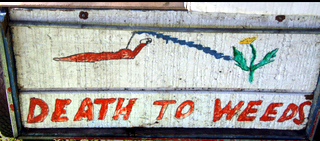 Every so often I come across an article that explains something so much better than I ever could. This is one of those times.
Tsu Dho Nimh writes a blog called Lazy Gardening SMACKDOWN. Back in 2013, he tackled the viral advice about making your own herbicide out of vinegar, detergent, and some other ingredients. I’ve been meaning to cover this topic, because this homemade “herbicide” doesn’t work. But then I saw Nimh’s article, and realized that he did a much more thorough job of explaining it all.
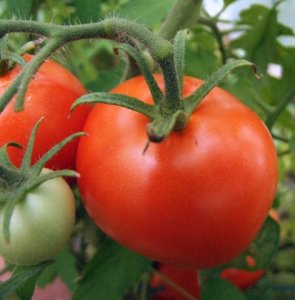 Summer is just around the corner and the weather is (hopefully) settled. You’ve finally planted your tomato seedlings and you’re dreaming of luscious, red, ripe tomatoes—the sooner the better.
However, this is Colorado, and there’s no guarantee when it comes to growing tomatoes. Now that your plants are in the ground, what’s the best way to care for them to ensure the biggest, fastest harvest?

Photography. The very word means “writing with light.” In spite of all our digital technology, light is still the most important aspect of a photograph. And light is often the difference between a nice picture and an outstanding work of art. The old masters knew this—think of Rembrandt, with the light illuminating his subject:
 The flowers could be considered somewhat pretty—a white or lavender tuft reminding me of cornflowers (aka bachelor’s buttons). The somewhat pretty flowers are probably the only positive aspect of these plants. A common noxious weed, knapweed is the bane of my garden.
The problem is that we live immediately adjacent to an open space, a few supposedly wild acres left by the developer (probably because it’s too steep to build on). There’s Gambel’s oak, six Ponderosa pines, a smattering of yucca, assorted wildflowers, and some rather nasty weeds.
 Mountain Plover