Can you name this bird? The photo was taken in Colorado in August. I will post the uncropped photo Saturday, giving you one more chance to identify this bird. The answer will appear at the end of next Monday’s post.


Can you name this bird? The photo was taken in Colorado in August. I will post the uncropped photo Saturday, giving you one more chance to identify this bird. The answer will appear at the end of next Monday’s post.

Flowers make me happy. I love gardens full of them. But while I do appreciate pretty bouquets, I prefer to receive flowers that are still attached to their plant. As my husband has learned—to bring a smile to my face, bring me flowers with roots!
(This post continues my series on birding in Australia… choose “Birding Trips” in the Category box at right to see my previous posts.)
I woke the next morning as soon as it was light and headed out the door, surprising several grazing kangaroos. I snapped their picture as they bounded away. Several Noisy Miners lived up to their name, making a racket in the early morning stillness. A pair of raptors landed on the top of a tall tree nearby. Pulling out my binos for a good look, I realized they were Ospreys—familiar birds. It seemed strange to see them so far from home.


 Should you top a tree to keep it within bounds?
A lot of what gets passed from gardener to gardener sounds like good advice, but has no benefit—or can even be harmful. Which practices are supported by research? Which should we forget about?
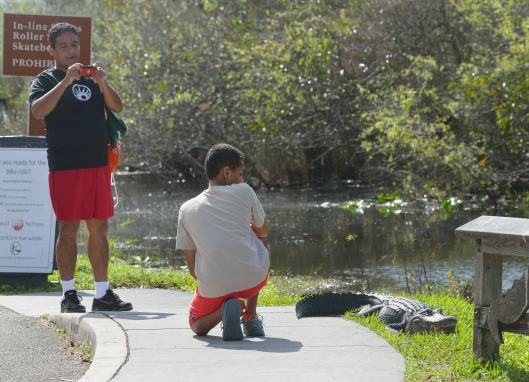
When it comes to wildlife, how close is too close?
We’ve all heard about the clueless tourists who want to snap a selfie with the bear or moose. All too often, someone ends up getting hurt. But you and I are sensible people who do not want to be spitted by a bull elk, or gored by a buffalo. So, how close should we approach these potentially dangerous animals?
 The link promised to tell me when I should start my vegetable garden—when to sow seeds indoors, and when to sow or transplant outdoors. Just type in my zip code, and I’d have information customized for my area, courtesy of the National Gardening Association. I rarely click on ads, but I’ve found the NGA to be helpful in the past. Besides, I was curious. I have 24 years of records telling me when to plant in my area—how would their site measure up?
 I’m gazing out my frosted window at the birds in our backyard. In the four hours since sunrise, the thermometer has only climbed from 13 to 15 degrees. Tiny snowflakes waft down onto the deck and bird feeders. The predawn fog has frozen onto every twig and blade of grass, turning the landscape into a fairyland of hoar frost.
The birds—House Finches, Dark-eyed Juncos, a few pigeon—are devouring my black-oil sunflower seeds as fast as their little beaks can crack the shells. A flicker has staked out the suet feeder. (I miss the nuthatches and chickadees from our old house, surrounded by pines.) But as popular as the feeders are, the birds are also flocking to my heated birdbath.
If you were stymied on Monday, now can you name this bird? The photo was taken in Colorado in February. The answer will appear at the end of next Monday’s post.

 I love to visit Washington. The state is a gardener’s paradise. All those dreary days translate into brilliant azaleas and rhododendrons, ferny grottoes, and towering evergreens. The trick is enjoying those gorgeous gardens when it’s raining—and it rains a lot. Sure, you can visit in the summer, when days are sunny and the sky is a sapphire blue. But what about right now?
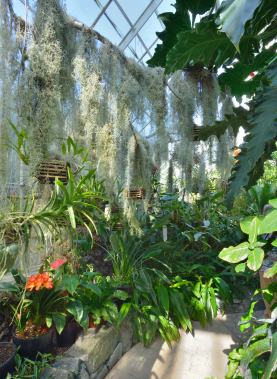
One way to get out of the February cold and wet is to visit a conservatory. (This applies to cold and snowy Colorado, as well.) And one of my favorites is the W. W. Seymour Botanical Conservatory, located in the 27-acre Wright Park Arboretum, Tacoma. This glassed enclosure houses over 250 species of tropical and semi-tropical plant, including 200 different orchids—just the antidote for a gloomy winter day.

Can you name this bird? The photo was taken in February in Colorado. (Due to the extreme cropping, some of these pictures are going to be smaller than has been typical.)
I will post the uncropped photo Saturday, giving you one more chance to identify this bird. The answer will be at the end of next Monday’s post.
 Mountain Plover