Someone left the screen door open, and suddenly our house is full of annoying, buzzing, flies. They circle the kitchen while I’m cooking, tangle with my hair while I’m sitting at my computer, and zoom past my Kindle when I’m reading in the evening. I have to ask, did we really have to have flies, God?
Category: Vertebrates
Magee in August
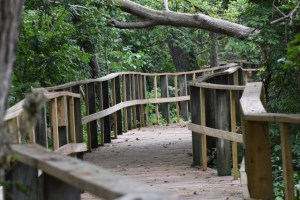 Sometimes you take a birding trip and it’s everything you ever dreamed about. Our time in Australia two years ago was like that. And sometimes, you try your hardest and things just don’t work out the way you anticipate, such as the trip we took exactly one year ago. Pete had arranged a series of work-related meetings in Michigan and Ontario, and I had never been there, so we decided to make a vacation out of it and drive around the Great Lakes. In the process, I visited my last four states, culminating in North Dakota as number 50.
Do You Hear What I Hear?
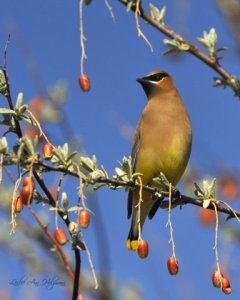 I was wandering through the forest in western Washington when I heard a series of high-pitched, whistling bird calls. As I peered into the foliage, I finally made out the Cedar Waxwings that were making the sound. Another time, I was in southern Texas, along the Rio Grande border. Again, I heard birds singling some very high notes. In this case, they were followed by a series of lower notes and a distinctive two-tone call. I realized that I was surrounded by a number of Ruby-crowned Kinglets.
In Memory of Motswari
 Colorado Springs gets a lot of hail. Anyone who has lived here very long knows that hail is part of life. But in the 25 years we’ve called Colorado home, we’ve never seen a summer like this one. Three times in the past three months, the south end of town has been pummeled by huge hailstones— softball-sized cannonballs from the clouds that demolished anything in their path. Gardens, cars, roofs, windows—the damage is devastating.
Sadly, the most recent storm also injured dozens of people, some seriously enough to be hospitalized, and killed five animals at the renowned Cheyenne Mountain Zoo. Today’s memorial post is dedicated to Cape Vulture (aka Cape Griffon) Motswari, an ambassador for her species and for vultures worldwide. (more…)
August Bird Quiz: Uncropped Photo
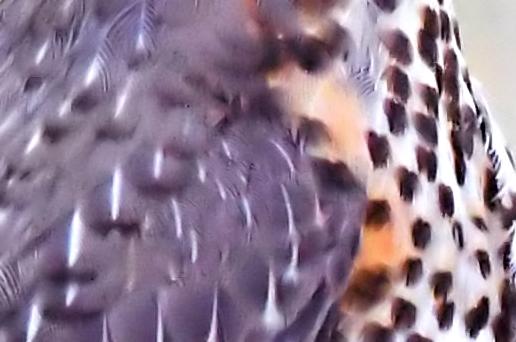
If you were stymied on Monday, now can you name this bird? The photo was taken in Arizona in May. The answer will appear at the end of next Monday’s post.

August Bird Quiz
Can you identify this bird? The photo was taken in Arizona during the month of May. The answer will appear next week.

A Tale of Two Chickadees
 While Black-capped Chickadees are familiar birds over the northern half of North America, Mountain Chickadees are a western specialty. True to their name, they care found at higher elevations from the Rockies westward to the Sierras and Cascades, and as far north as the Yukon.
Mountain Chickadees are also selective about their habitat, preferring to hang out in conifer forests. This is why we enjoyed them at our last house, where we were surrounded by ponderosa pines. Our current home is in a new neighborhood lacking mature trees. Hoping our old friends would still come and visit, we included two fairly large Austrian pines and a dwarfed cultivar of a limber pine, (Pinus flexilis ‘Vanderwolf’s Pyramid’) in our new landscape. It took three years, but the birds are finally here.

Good-bye Gray Jay
 One aspect of nature I appreciate is its constancy. No matter who gets elected, a rose is still a rose. Whether I’m happy or sad, a moose remains a moose. The world can fall apart, but a jay is still a jay. Or not.
That’s right. This year, the American Ornithological Society (AOS, formerly the AOU) has voted to rename the Gray Jay. From now on (or should I say “once again”?), this personable gray-and-white bird will be known as a Canada Jay.
July Quiz: Uncropped Photo
If you were stymied on Monday, now can you name this bird? The photo was taken in Colorado in July. The answer will appear at the end of next Monday’s post.

July Bird Quiz
Can you identify this bird? The photo was taken in Colorado in July. I will post the uncropped photo on Saturday, giving you one more chance to identify this bird. The answer will appear at the end of next Monday’s post.