
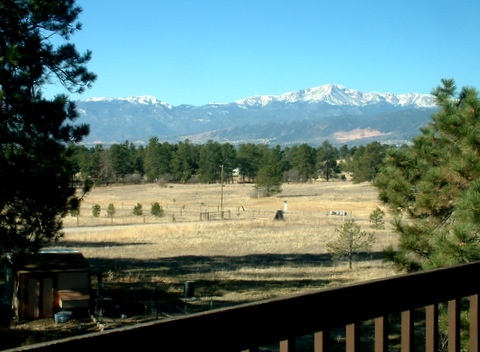
 I miss my birds. Until a month ago, we lived on almost five acres outside of town, with huge Ponderosa pine trees and a two-acre field. My yard list numbered over 60 species. I could stand at the kitchen window and watch three species of hummingbird at the feeder hanging from the eaves, and enjoy the antics of the Bluejays, Steller’s Jays, and Scrub Jays as they competed with the magpies for peanuts left on our balcony railing.
Category: Plants
No Junipers for Me
 I really don’t like junipers, but it’s not their fault. Rather, I blame the landscapers.
Think of the countless homeowners who plant Pfitzer junipers (Juniperus chinensis ‘Pfitzeraiana’) in front of their living room windows, then shear them to a fraction of their normal size. That’s not fair to the plant, it’s unattractive, and it makes a lot of work for the gardener.
Similarly, junipers are planted along sidewalks and in parking lots (where they tenaciously hang on despite compacting foot traffic and scorching summer heat). Quickly outgrowing the space allotted, they’re pruned at the edge of the pavement, resulting in a wall of dead, brown branches.
Pretty Flower, Icky Name
 It took me a while to warm up to a plant named “Spiderwort.” I kept getting this mental image of a cross between the crone in a fairytale (with warts on her nose) and a sinister tarantula. Not appealing!
Of course, worts are small plants used as food or medicinally. It’s not at all the same word as “wart.” And a Spiderwort is no more likely to host a friendly spider than any other garden plant. (Their common name comes from the silk-like threads of hardened sap that seep from a cut stem.)
I was finally won over by the beautiful blossoms and all-around toughness of this worthy garden perennial.
Answers: Weed? Or Wonderful?
If you’ve ever pulled out the lettuce and left the chickweed, you’re in good company. Last week I admitted my failure to recognize ragweed, one of the most irritating plants in my yard (especially to my nose!). It takes practice to recognize plants in their infancy. After all, how much do you look like your newborn photos?
If you missed last week’s quiz, you can try your hand at some seedling ID by clicking here. If you’re ready for the answers, keep reading.
Weed? Or Wonderful?
 Everything is growing. Buds are bursting, early flowers are in bloom, and millions of tiny seeds are breaking through the soil into eager growth. It’s a wonderful time of year, and a busy one for gardeners. As we sow seeds and pull weeds, the question arises—which is which? Should we dig out that clump of green, or is it a desirable plant?
This is especially difficult if it’s a new yard, and this is our first chance to see what’s growing in it. Let me tell you a short story illustrating my gardening ineptitude.
Finally, Manzanitas for Colorado!
 Finally, manzanitas for Colorado gardeners! When we first moved to Colorado, back in 1993, I wanted to add some manzanitas to our ponderosa forest landscape, but the cultivars available weren’t deemed hardy enough for our 7000 foot elevation. I gave up and settled for Mahonia—not at all the same thing, but about the only broad-leafed evergreen I could get to grow in my yard.
Yellow Leaves with Green Veins
 Colorado—the word means “red” in Spanish. And Colorado’s soils are often reddish, due to the abundance of oxidized iron. Here in Colorado Springs, Garden of the Gods (right) attracts visitors with bright orange sandstone monoliths. Further north, Red Rocks Park and Amphitheatre is part of the same formation. Our well water has so much iron in it that our white laundry turned pink—we had to install an iron-removal component to our water system.
So, with all this iron present in our soils, why do so many plants here suffer from a deficiency?
Beyond Crabapples: Another Flowering Tree for Spring
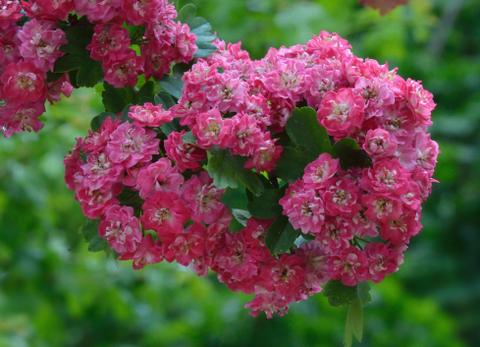 When it comes planting a spring flowering tree, most Colorado gardeners immediately think of crabapples. Wildly popular all along the Front Range, crabs deserve their stellar reputation. However, they aren’t the only flowering tree that thrive in our harsh environment. There might even be a better choice! Consider their close relative, the Hawthorn.
What Did You Say?
 Many people talk to their plants. Whether or not it makes a difference, we chatter on about the weather, how nice the plant is looking, perhaps how shiny a leaf or pretty a flower. Of course, the plants don’t really hold up their end of the conversation. I’ve heard nary a peep from my peony, nor a single ahem from my Agastache. Even if they could talk, I doubt we’d find the conversation stimulating. After all, plants don’t have brains. But a lack of brain and vocal cords doesn’t stop plants from communicating. We just have to learn their language.
Grow for the Green

When you think of flowers, you might imagine a red rose, yellow daffodil, or purple iris. But how about green? On March 17 we will celebrate Saint Patrick with green eggs, green beer, and parades. Being a gardener (and in honor of an Irish ancestor), I want flowers to get equal time.
 Mountain Plover