
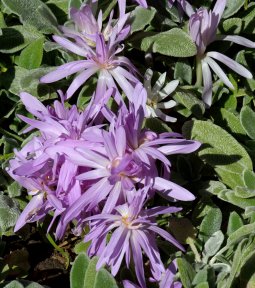
 When we think of crocuses, we imagine the first flowers of spring, daring the cold and snow to herald the coming change of seasons. And just as crocuses start the growing season, they can also be among the final flowers of fall. You may know them as Meadow Saffron or Naked Ladies (although that name also belongs to Amaryllis belladonna)—these goblet-shaped pink–to-purple flowers that spring leafless from the ground in early autumn. They don’t last long, only two or three weeks, but their presence when all else is fading makes them worth the effort.
October Bird Quiz
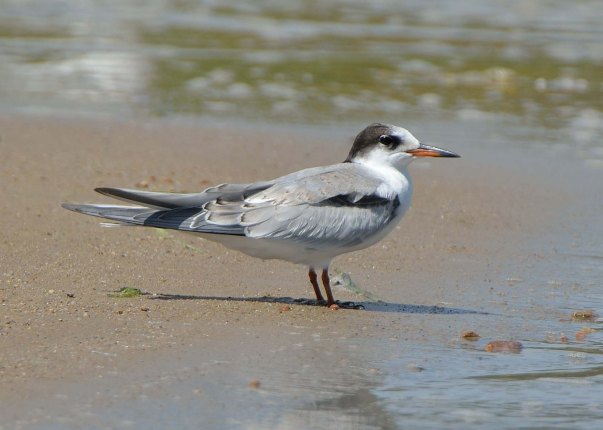
Can you identify this bird? The photo was taken in Colorado at the end of August. The answer will appear next week.
Australia Adventures
 As you read this, my husband and I are on our way to the land of wallabies (right), waratahs, and wattles. Yup, we’re going to Australia! This amazing country has been on my “bucket list” since I was thirteen, and we’ve been saving for it forever. I might be just a teeny bit excited.
 While my husband wants nothing more complicated than a well-deserved hammock on the beach, I want to see the continent’s unique birds and plants. That means spending a lot of time outdoors, and that means that, besides the kookaburras (left) and kangaroos, there are a number of less-than-friendly creatures I might encounter.
Pishing, Hooting, Playing a Recording
 You’re out birding at the local marsh, facing a sea of cattails and reeds. Somewhere in that vast expanse is a Black Rail. How in the world are you going to find it? What are the odds of it sauntering out of the dense growth right in front of you? If left to their own devices, very few Black Rails—and other very secretive birds—would show up on any birders’ life lists.
Birders do check off rails—and Swainson’s Warblers, nocturnal owls, and other hard-to-find species. Frequently these birds are prodded into announcing their presence by the use of recordings.
Garden Advice: Using Salt in the Garden
 One of my perverse pleasures is perusing Pintrest to find bad garden advice. There’s certainly no lack of misinformation on the web, and Pintrest seems to collect it all. Most advice is simply a waste of time and money—sprinkling Epsom salts on your plants, spraying weeds with vinegar, pouring beer on your lawn. They don’t help, but they won’t kill your plants either. However, yesterday I came across a recommendation that will seriously damage your garden. I was so horrified that I immediately sat down to write this post.
Splitting Jays
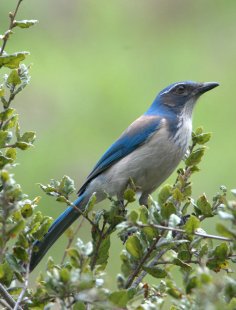 Heinlein said that there’s no such thing as a free lunch.* He must not have been a birder. When the American Ornithological Union met this year, many birders added a new species to their life lists without even leaving their arm chairs. It’s time to update our field guides—even the brand new Sibley’s. The Western Scrub-Jay has now been split into the California Scrub-Jay (Aphelocoma californica, left) and the Woodhouse’s Scrub-Jay (Aphelocoma woodhouseii).
Applauding Leadplant

Sometimes I think of leadplant (Amorpha canescens) as the ugly duckling of xeric shrubs. It’s just not appreciated. Consider this quote from the Missouri Botanic Gardens (MBG) webpage:
A somewhat ordinary looking, small shrub with an attractive bloom but otherwise with no particularly outstanding landscape features. Good plant for naturalizing in a native or wildflower garden, prairie or meadow.
September Quiz Answer
To refresh your memory, here is the photo from September’s Bird Quiz. The bird was seen in Colorado during the month of August. Don’t read any further if you want one last chance to identify this bird.

Villainous Voles
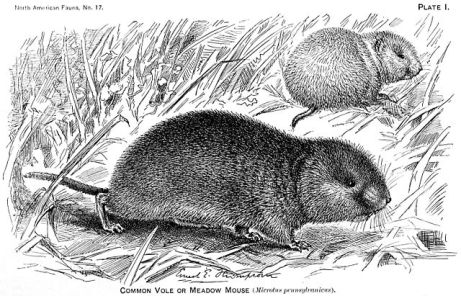
In last month’s post on “Who Ate My Plants?” I described the following scenario:
The heavy snowfall took a while to melt, but finally your dormant lawn emerges from under its frozen blanket. Last time you saw it, it was perfect turf, smooth and even. But now, it looks as if an army had performed maneuvers across your yard! Shallow furrows run here and there around islands of still-intact grass. What in the world?!
September Bird Quiz
Can you identify this bird? The photo was taken in Colorado during the month of August. The answer will appear next week.

