
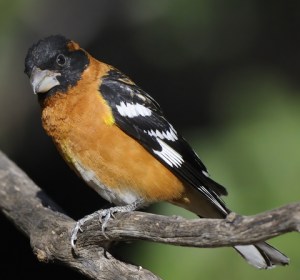
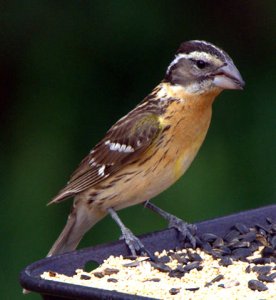
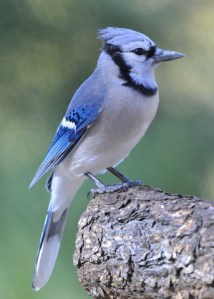
 Male ducks don’t look anything like female ducks, at least during the breeding season. And you can easily tell the boy Black-headed Grosbeaks (right) from the girls (below)… in fact, they don’t look like they even belong to the same species! But with lots of birds, from Steller’s Jays to Canada Geese, it seems that only they know who is who.
I’ve often wondered just how they do that. What is it that tells male Red-tailed Hawks who the ladies are? How do California Gulls avoid courting a gull of the same sex? Well, I just read some fascinating articles that solved this mystery, at least when it comes to Black-capped Chickadees.


 It’s time to clean out the chicken coop. All summer my little flock has been happily picking weed and grass seeds out of the straw I spread in their coop last spring. At the same time, they’ve broken down the big pieces of grass stem into finer shreds. And, best of all, they’re balanced all that carbon with some nice, hot chicken manure.
 Honk, honk
 Last night WeatherBug was blinking a frost alert—the first of the season—and sure enough, there was ice on our birdbath this morning. I hate to admit it, but summer is over. I don’t mind the end of the cucumbers; they were overly prolific this year. And the carrots are safe underground for months to come. What I miss are the fresh herbs that we’re still enjoying. So, they’re moving back in with us.
 I was rinsing my hands under the faucet downstairs when a huge, aggressive monster suddenly scurried across the bowl of the sink. I screamed. Slamming the faucet lever down, I backed away from the counter, shaking, dripping on the tile floor.
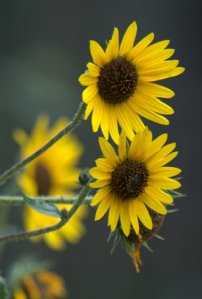 This year, the birds planted themselves a garden.
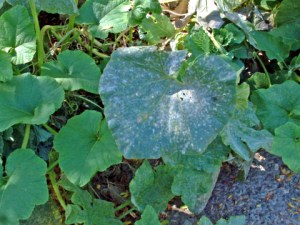 The huge zucchini leaf looked as if it had been dusted with flour. The man holding it was looking at me expectantly, waiting for my diagnosis. I was volunteering at our county’s Master Gardener helpdesk, providing free gardening advice to the general public. Sometimes we get stumped, but this time I immediately knew exactly what the problem was.
