I have a post all ready to go for today, but when a friend shared this news report with me, I just had to share it with you. Be sure to read the comments! This is why we need science education.
Cleaning up with bugs

I have a post all ready to go for today, but when a friend shared this news report with me, I just had to share it with you. Be sure to read the comments! This is why we need science education.
 Our family loves bok choy, so I always plant at least one block of the baby variety. And every year I harvest bok choy that looks as if it’s been peppered with buckshot. I can explain that I washed the leaves and they’re perfectly safe to eat, but really—who wants to eat leaves that were eaten by something else first? Ewww.
The culprit behind all those holes is an aggravating insect called a Flea Beetle. No, they aren’t really fleas, and they only bite plants, not people. If you look closely, you’ll see they’re shaped like beetles (fleas are vertically flattened). Still, they are very small, dark brown to black, and they can jump—just like fleas. And just like fleas, they can drive you crazy.
 Last month I explained how amphibians, such as frogs and toads, and reptiles, such as snakes and lizards, are beneficial to our gardens. This time I’ll focus on birds and mammals. Inviting these wild animals into ours gardens is yet one more way that we can control the pests that dine on our flowers and veggies.
Birds
As an avid birder, I have up to a dozen feeders scattered around our yard. It may seem as if I’m doing the birds a favor, but it’s really the other way around! While most birds attracted to feeders eat seeds, many of those same species switch to bugs, with their higher protein content, during the breeding season.
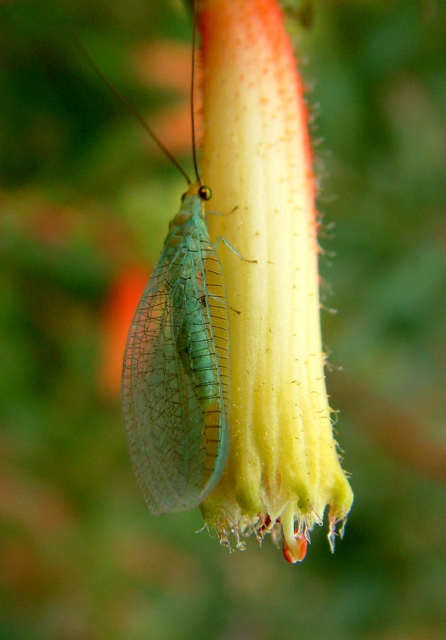
 If we set a thief to catch a thief, then why not set a bug to eat a bug? Sometimes the best way to control an outbreak of an insect pest is to use another insect, or a close relative (such as spiders). Ladybugs, the most famous of these insect killers, are wimps compared to some of the other predatory critters in your garden. Lacewing larvae, ground beetles, praying mantises, wasps, hover flies, spiders… there are plenty of beasties who are more than happy to keep garden pests under control.
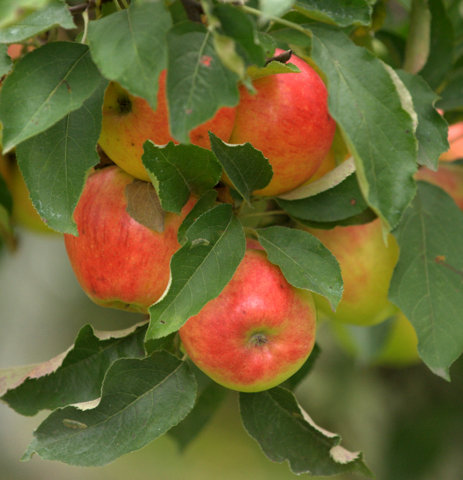 Let’s say you want to grow apples in your Colorado garden—a perfectly reasonable option for this area. You’ve selected a variety that’s resistant to fireblight (I discussed disease-resistant varieties in May), and your tree is thriving. In fact, after several years, it’s finally beginning to bear fruit. You pick your first juice, red apple, take a big bite, and… oh no! Yup, you find half a worm. Ewwww.
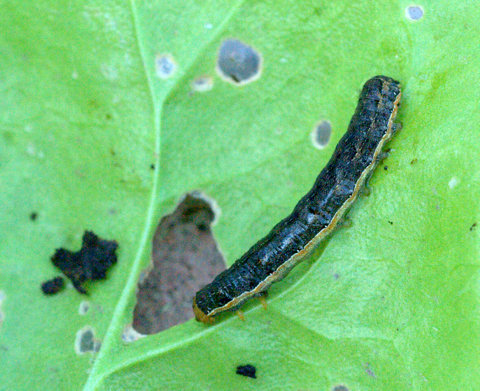 The best way to ward off insect and disease problems is to grow a healthy plant. Just as a wolf pack will target the weakest member of a herd, insects seem to zero in on a plant that is under stress. Good gardening practices—choosing the right plant for the spot, soil preparation, proper planting, feeding, watering, mulching, and the like, all go a long way to keep our gardens free of damaging pests.
But cultural control goes further than just having a green thumb. Sometimes our yards are invaded by insects no matter how good a gardener we are. In that case, it pays to know the enemy.
 Is your garden being bugged? While 95% of all insects are either beneficial or benign, that last 5% can eat us out of house and home—or at least out of cabbage and broccoli. If insect invaders are on the attack, sometimes you just have to fight back.
Pests may be persistent, but we gardeners are not helpless. I like to remind myself that I am smarter than an aphid and more cunning than a flea beetle. When it comes down to a battle for the harvest, there are lots of tools at our disposal. As a master gardener, I was taught the principles of Integrated Pest Management, or IPM. Rather than just reaching for a spray can, this approach is multifaceted. There are many ways to outwit a weevil.

What do Minute Maid® or Ocean Spray® ruby red grapefruit juice, Revolutionary War British soldier uniforms, and Almay lipstick have in common? Yes, they’re all red. But there’s more to it than that. They, along with a myriad of other cosmetics, foods, and a few fabrics, all contain a red dye known as cochineal red or its derivative, carmine.
Almost everything these days contains some sort of artificial color. While some people avoid these dyes, most don’t think twice even if they do happen to read the label. Besides, cochineal isn’t artificial. It’s a natural product that has been used for hundreds of years.
So just what is it, and where does it come from?
 With temperatures dipping into the low 20s and our first (finally!) snowfall, the bugs in our gardens are either dead or in hiding. But before we collapse into that comfy recliner with a garden book and a cup of tea, we need to take a good look at our houseplants. It might be winter outside, but indoors the bugs are having a field day.
At least they are at our house. I’m currently at war with some aggressive invaders. They’re about an eighth of an inch long, are covered with sticky, gooey, white fluff, and are wedged into the leaf axils of many of my favorite houseplants. Yup, my indoor garden has mealybugs. (more…)
 Just the title evokes images of a Japanese horror movie with giant beetles running down the streets of Tokyo, grabbing screaming people and crunching them between its mandibles.
That is not what this book is about.
Rather, it’s about the many and varied ways that humans consume insects, arachnids, and other creepy-crawlers. There are plenty of graphic color photographs, too.
 Mountain Plover