Garden Whimsy

Today is the 5th Thursday of the month, so it’s time for a break. I thought I’d post some fun garden photos I’ve taken over the last few years. No one ever said you had to be serious in your garden! I hope these put a smile on your face, and perhaps inspire you to create your own unique garden feature.
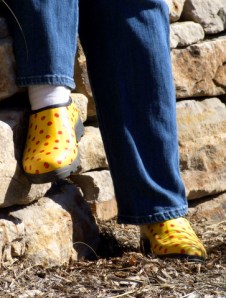
fashionable-gardening-shoes-carnegielib-16apr07-lah-754

To start with, how about some ladybug garden clogs? These are so cute, I’d hate to get mud on them! One of our Colorado master gardeners was wearing these.

(more…)

Caliope Hummingbirds


calliope-hummingbird_blkforest-co_lah_6692How can a bird be that tiny? And how can anything that tiny have that much stamina?

I’ve been sitting at my dining room table watching the Broad-tailed and Rufous Hummingbirds compete for the feeders hanging outside the window when I notice a third species, even smaller than the pugnacious Rufous male hogging the sugar water. It’s our annual visit of the Calliope Hummingbirds! With a length of only 3.25 inches, and a body weighing in at one tenth of an ounce, the Calliope is the smallest bird in the North American bird area. (more…)

Mountaintop Birds

mtevans-co_lah_4844nef

My husband and I aren’t the only ones who escape the heat by fleeing to high altitudes. A number of bird species do the same thing. Instead of migrating to the arctic, they head for the hills.

I was a first-year birder, a mere fledgling. Our local Audubon chapter was offering a trip to the high country. Of course I signed up. Surely there were amazing birds to be seen at such rarefied heights. I was expecting something new and exciting— a Williamson’s Sapsucker, perhaps, or one of the rosy-finches. Maybe we’d even spot a well-camouflaged ptarmigan!

We piled out of the cars at the top of the first pass, and I raised my binoculars to scan the scattered patches of melting snow and dwarfed willows. There! What as that moving in that patch of wildflowers? It’s a… it’s a… robin? I came all the way up here to see a robin? I have plenty of robins in my yard, munching on my gooseberries and chokecherries!

(more…)

The Return of the Swainson’s Hawks

swainsons-hawk_lakepueblosp_lah_4891

It’s time for the changing of the guard. Rough-legged Hawks are on their way to the northern edge of the continent to breed and raise their young in the 24-hour summer sunshine. At the same time, Swainson’s Hawks are on their way back from Argentina in search of an endless summer.

Swainson’s Hawks were the first hawks I learned to identify as a fledgling birder. The dark-dark-light pattern of perched birds is easy to remember—dark head and chest, white belly. Plus, the russet cowl is distinctive. Smaller than other Colorado Buteos, their tiny feet allow them to perch on wires whereas other Buteos prefer trees and telephone poles. A friend described the white over their beak as their “searchlight” and the mnemonic stuck. And finally, no other American hawk has pale coverts with dark flight feathers. A soaring bird is instantly recognizable.

(more…)

Go for the Green

fraxinus-pennsylvanica-green-ash-cc-2003jul06-lah-003

In honor of today being St. Patrick’s Day, I thought I’d celebrate “green” in the garden. No, I don’t mean about being environmentally friendly, although that’s certainly important. I’m talking about just plain green… as in chlorophyll-laden leaves.

This time of year, I’m pretty frantic for anything green. There aren’t many broad-leaved evergreens that tolerate Colorado’s winters. Even the conifers are more a blackish-olive drab—not nearly as nice as the “pine” of the decorating industry. Cold weather does that to leaves: many junipers turn plum-purple in winter. Leaves should not be that color. (Mahonia wears the same hue, but manages to look more attractive in it.) Hardy ice plant glows red, and ornamental grasses shimmer in copper and gold. Mostly, however, things look dull grayish brown, or just plain dead.

(more…)

Flamingos

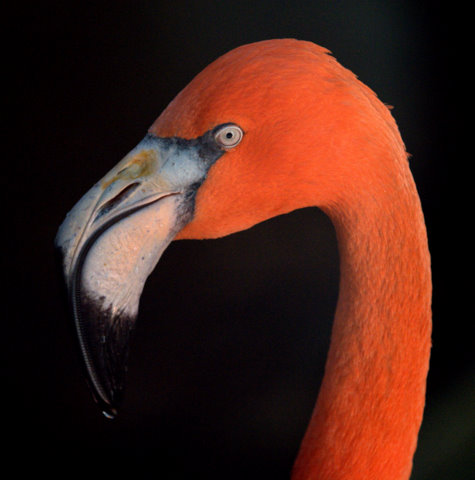
american-flamingo_denverzoo_lah_4364When I was growing up, our elementary school classrooms were always decorated in seasonal colors… black and orange for October, red and green in December, and pink and red for February. Therefore, in honor of that long-lasting tradition, today’s post is about one of our most popular pink birds.

When we think of pink, the first bird that probably comes to mind is the flamingo. While there are six species of flamingo worldwide, and four in the Americas, only one is found wild in the United States—the American Flamingo. Even then, it takes a lot of effort and even more luck to actually see them in the US. Their normal range encompasses the Caribbean and the Galapagos (these two populations are divided into two subspecies), and only rarely are they seen near the southern tip of Florida. (more…)

Incredible Hummingbird Video

black-chinned-hummingbird_redrocksranch-hwy115-co_lah_3777

It seems that everyone loves hummingbirds. Their tiny size, incredible gymnastic feats, and bright colors are enough to win over even the most apathetic bird-ignorer. (Is that the opposite of a bird watcher?)

PBS, through the design and construction of a special camera, has made a documentary about these amazing birds that slows their life down to mere human speed. I was astonished at what I learned.

I missed this video when it first came out last year. Maybe you did too. So instead of writing my own article for today, here are two links, one to the full-length video and one that shows how the filming was accomplished:

Hummingbirds: Magic in the Air
Behind the Scenes of “Hummingbirds”

I hope you enjoy them as much as I did.

Red-Winged Blackbirds

As birders, we have a tendency to sneer at common species, even disparaging them as “trash birds.” One of my birding resolutions for 2011 is to learn to appreciate all species, no matter how mundane. Learning more about their lifestyles is a step in that direction.

red-winged-blackbird_fcnc-co_lah_1218-aEven before I was a birder, I could identify the male Red-winged Blackbird. Found in shallow marshes and other wetlands around the country, the black bird with the red and yellow shoulders is a familiar sight. Even the little drainage pond at the end of our street, with its sparse patch of cattails, is home to a few of these noisy blackbirds. (more…)
Pygmy Cuties

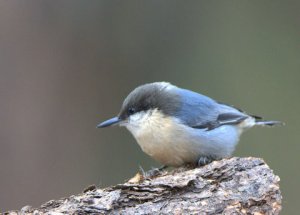
pygmy-nuthatch_blkforest-co_lah_0601They’re adorable, with their short stumpy tails, tiny bodies and toddler-round tummies. They’re constantly active, hopping from branch to branch. Can you tell? Pygmy Nuthatches are one of my favorite birds! I love to watch them fly down to the feeder to grab a seed, then bolt back into safety before “hacking” (“nut hack” has become “nuthatch”) the sunflower shell open against a branch. Sure seems like a lot of work, especially compared to the finches who just sit there shelling and swallowing seeds as fast as they can.
Like so many other animals—dolphins and penguins come immediately to mind—Pygmy Nuthatches are dark on top and light underneath. This pattern helps disguise them from potential predators. Seen from above, their dark gray color blends with the ground (or tree trunks), while their white undersides are hard to spot against a brightly lit sky.

(more…)

Turkey Vultures

turkey-vulture_parguera-pr_lah_7209c

Q: Why didn’t the Turkey Vulture pay the airline’s luggage surcharge?
A: All he had was carrion.

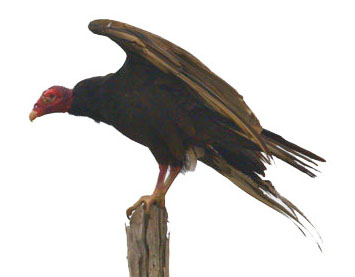
Frequently portrayed as sinister black birds hunched over a dying cow or feasting on road kill, Turkey Vultures could be the perfect Halloween birds. But are they really as evil (or disgusting) as the image suggests? Get to know them a bit better, and you might be surprised at how interesting these huge birds can be. You might even find them endearing.

(more…)