
 Once again it looks like everyone is coming to our house for Thanksgiving. I have no problem stuffing and cooking a turkey, whipping up some tasty gravy, or baking delicious pies. I enjoy cooking, and I’ve made plenty of turkey dinners. I’m the kind of cook who works hard to get the flavors I want, but forgets about presentation. When it comes to Thanksgiving dinner, what stumps me is decorating the table.
My first inclination is to just pick up a small potted mum from the market and plop it down in the center of the table, perfectly blocking the line of sight between Aunt Abigail and Cousin Clarence. It’s easy and I gain a plant out of it. However, it has its drawbacks.

 How would you like a houseplant that isn’t fussy about food, water, light, or much of anything else, is ignored by pests, and looks good year round? If that seems too good to be true, then you haven’t met the Ponytail Palm. Granted, I have yet to see flowers, but with all its good points, who cares about flowers?
 Everywhere we turn, we see red. Poinsettias decorate our homes, churches, businesses and stores. How did a tropical plant become such a pervasive symbol of Christmas? Are poinsettias poisonous? And what should I do with my plants once the holidays are over?
 Are you missing succulent green foliage, fragrant flowers, and that humus-y smell of living soil? It may be too cold to garden outside, but it’s a great time to focus on houseplants.
 Tomorrow is Good Friday, the day Jesus wore a crown of thorns. In visualizing that painful headpiece, it helps me to think about the sharp spikes on the plant with the same name.
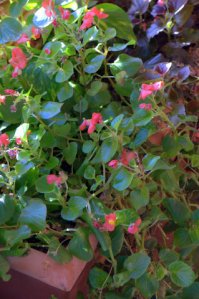 What plant thrives indoors, shrugs off low humidity, and blooms all winter in bold shades of white to pink to red? Surprise! It’s wax begonias!
 With giant, trumpet-shaped flowers facing outward around a central stalk, a blooming amaryllis makes an eye-catching houseplant. Colors range from white through pink to red (and even almost black), as well as salmon-orange. Stripes or contracting edges are common. “African” amaryllis have more compact forms suited to indoor cultivation. Dwarf amaryllis are smaller in size but can produce more blooms.
 Mountain Plover