Mid-Summer Abundance

american-robin_juv_blkforest-co_lah_4249a

July is not the best time to go birding. The sweat drips from under your floppy hat and smears the view through your binos, and there’s a puddle soaking your shirt under your sling/backpack/fanny pack. It’s a challenge just carrying enough water to stay hydrated.

The birds aren’t cooperating, either. Most of the males have stopped singing now that they have their mates and their territories. Soon they’ll be molting out of their breeding plumage into something much duller and harder to identify. Some are already thinking about heading south, although they won’t actually leave town for a few more weeks.

(more…)

Locoweeds

oxytropis-lambertii_locoweed_kcs-co_lah_3438nefI was hiking on a nearby ranch last week when we came across some spectacular wildflowers. As I knelt to grab some photos, my plant expert companion remarked, “You know that’s locoweed. We should pull it out!”

What? Destroy these beauties? Why? I was about to receive an education.

Locoweed (or crazyweed) is the common name for two genera of western plants, Oxytropis (left) and Astragalus (also called milkvetch), both in the pea family, and both including some species that contain the toxin swainsonine. Swainsonine interferes with protein metabolism and causes nerve damage.

(more…)

Grow Veggies, Save Water

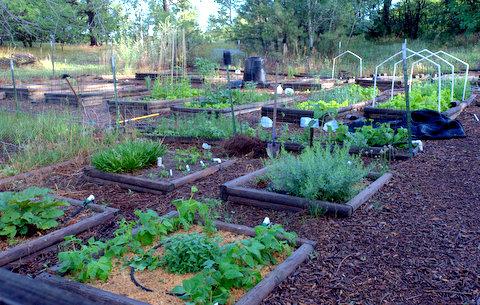
community-gardens-bearcreek-lah-003According to a recent report from the U.S. Dept. of Agriculture, “Extreme drought conditions exist from Colorado Springs and Pueblo to the San Luis Valley and over most of the plains to the southeast of the big metro areas.”

If you live here, this isn’t exactly news. The fields are turning brown months early, wildflowers are small and sparse, and even the most aggressive weeds are wilting.

Living in the low-rainfall west, we’re used to gardening with minimal water. Xeriscaping is a household word, and basic principles of low-water gardening are widely available. (I’ve written several posts on it too—just type “xeriscape” into the search bar.)

(more…)

Welcoming Butterflies

742-butterfly-on-lavenderInsects have a pretty crummy reputation. Not too many people are enamored with flies, roaches, or wasps. Yet, there are a few exceptions, such as ladybugs, honeybees (in the right setting), and of course, butterflies. Who doesn’t appreciate butterflies? We’re taken with their beauty, and we hope they’ll visit our gardens. Happily, there are a number of steps we gardeners  can take to encourage these “flying flowers.” Creating a landscape that welcomes butterflies isn’t difficult, and it will appeal to people just as much as it does to the butterflies.

Most importantly, don’t spray insecticides in your yard. You’re trying to encourage butterflies and caterpillars, not kill them! If you do have a pest problem, make sure to identify the culprits before taking action. Sometimes spraying isn’t the best option. If you decide you need to apply a pesticide, use it selectively on the plants under attack. Don’t go wild with the sprayer.

(more…)

Foxglove ‘Spanish Peaks’

 (Digitalis thapsi)

digitalis-thapsi-spanish-peaks-dbg-lah-002rWith one- to two-foot spikes of raspberry-pink flowers over a tidy mat of fuzzy foliage, perennial foxglove ‘Spanish Peaks’ isn’t your typical foxglove. Instead of the cool humidity of the British Isles, this hybrid is specifically recommended for Colorado gardens, doing well in our arid and unpredictable climate. As a result, it was named a Plant Select winner in 1999. The cultivar’s name reflects both the plant’s Spanish origins, and it’s suitability to Colorado, home of the Spanish Peaks.

Although attractive to bees and hummingbirds, ‘Spanish Peaks’ is usually disliked by rabbits and deer—probably due to its poisonous foliage. (The drug digitalis comes from plants in this genus.)

(more…)

Eating Locally in Colorado?

How much is local?
How much is local?

All over the country, foodies are advocating the wonderful benefits of eating locally. Save on transportation costs (both financial and environment). Know where your food came from and who grew it. Fresher is healthier. There’s no shortage of good reasons to base one’s diet on food produced within a hundred mile (approximately) radius. In fact, several noted authors have written books on the topic.

(more…)

Forget-me-not (Myosotis sylvatica)

myosotis-forget-me-not-dbg-lah-011rAppearance
The petite, sky-blue flowers of forget-me-nots have charmed gardeners for ages. Also available in delicate pink or white, the blossoms are suspended by wiry stems above crinkled, heart-shaped leaves of forest green. The plants form a groundcover six to twelve inches high and two feet wide. Even though the species is native to Europe, it has naturalized in North America to the extent that the Forget-me-not is the state flower of Alaska.

(more…)

When Is the Last Frost?

frosty-tree-home-2009-02-14-lah-253

This last week of gorgeous spring weather has certainly brought out the crowds at the garden centers and home improvement stores. When I visited last weekend, carts full of geraniums, tomatoes, and other tender annuals were lined up at the checkout.

Today, the forecast is for snow. It was 30 degrees when I got up this morning. There was frost on the parked cars. As I type, big flakes are softly landing on the freshly turned soil out my window. I wondered how many of the people I’d seen at the store had gone home and planted their flowers, only to find them blackened after the sub-freezing night.

(more…)

Wind

windy_5

I know that wind is merely “air in motion,” but why does it have to be in such a hurry?

Here in Colorado, the wind has been blowing for weeks now—and not just gentle breezes, but howling gales that topple trees and suck every drop of moisture from already desiccated soil. First a dry winter, now this ceaseless wind.

As a gardener, there are times when I’m totally frustrated by too much wind. It stunts the growth of tender new shoots (I’m not trying to create bonsai tomatoes, but sometimes that’s what I get) and makes working in the garden a miserable experience.

(more…)

Planting Done Right: Part 2

Trees

tilia-x-europaea-linden-cc-2003jul06-lah-003Today is Arbor Day, the traditional day for planting trees. Most of us treasure trees. Planting one is an act of faith, something we do for our children, and perhaps our grandchildren. Sadly, thousands of our nation’s trees now reaching maturity are destined to an early death. They were doomed the day they were planted.

Gardening practices have changed over the years. The days of digging a huge hole for a new tree are over. Research has shown that planting a tree too deeply is a sure recipe for trouble.

(more…)