If you were stymied on Monday, now can you name this bird? The photos were taken in California. The answer will appear at the end of Monday’s post.


If you were stymied on Monday, now can you name this bird? The photos were taken in California. The answer will appear at the end of Monday’s post.


Family Amaranthaceae has a lot of members—over 2,000 species. You will likely recognize many of them. Some are ornamental—think of the garden annuals Gomphrena, Ptilotus, and Love-lies-bleeding (Amaranthus caudatus). The Celosias are also amaranths—you might know some of them as the old-fashioned flower Cock’s Comb.
Here’s another bird from warmer climes. It was photographed near Half Moon Bay, California, in March, 2013. Can you name it? I will post the uncropped photo on Saturday, along with some more photos of this species, giving you one more chance. The answer will appear at the end of next Monday’s post.


I love Asian cooking, or at least the American version of it. (I didn’t recognize anything on the buffet at the hotel in Bangkok!). Anything with plenty of onions, garlic, and ginger makes my mouth water. I’ve grown onions and garlic before, when I had more room for such things. But living in the cold part of Zone 5, any ginger I planted would have to be in a pot so I could bring it in for the winter. And at the rate I use ginger, it just didn’t seem to be worth the trouble.

After the storm earlier this week, snow blankets the fields, hiding most signs that anything ever grew there. But interspersed with the even white blanket and occasional dried grass leaves are spikes, sticking up like posts in the empty landscape. We’re finally noticing the dead and dried flower/seed stalks of Common Mullein (Verbascum thapsus).

I hadn’t really planned to spend time birding in Minnesota. We were on a road trip around the Great Lakes, and we had finally turned toward home. But my high expectations for Whitefish Point, in northeastern Michigan, had been squelched by high winds, and we decided to cut and run, saving the time to spend someplace more accommodating and birdy. That someplace turned out to be Hamden Slough NWR.
 I sat munching my seedless grapes, enjoying the sweet juices. I bit one in half, and focused on the tiny, immature lumps that would have been seeds in another variety. I’ve always taken seedless grapes for granted, but now I wondered—why didn’t the seeds develop in this cultivar? It clearly goes against a plant’s nature to grow fruit without seeds.
And what about watermelon? Is the same process involved? And those name brand tangerines we just polished off didn’t have seeds either. These days, even bananas are seedless. I miss the little black dots that used to decorate my banana bread. Then there are seedless tomatoes and cucumbers, two more fruits, at least from a botanist’s perspective. I had never stopped to consider how many seedless fruit crops are now available.
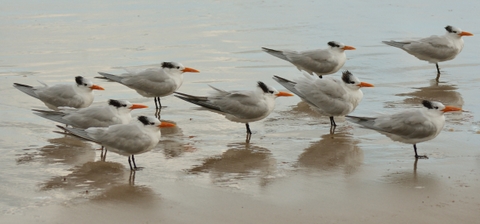
Pete and I have been invited to visit friends in Florida next month. Of course, we accepted the invitation! I’ve arranged time off from work, I’ve made my packing list, and our house sitter is all lined up (with instructions on keeping the feeders filled). Now I’m eagerly counting the days until we leave.
While there are plenty of logistics involved in escaping winter for a couple of weeks, I’m also trying to prepare for birding in a relatively unfamiliar location. Yes, I’ve been to Florida before—twice, in fact—but it’s not my usual birding location, and those aren’t my usual birds.
If you were stymied on Monday, now can you name this bird? The photos were taken in North Carolina on December 30, 2013. The answer will appear at the end of Monday’s post.


In case you haven’t yet heard, the 2019 Pantone color of the year is Living Coral. According to Pantone, Living Coral is an “animating and life-affirming coral hue with a golden undertone that energizes and enlivens with a softer edge.” Coral has always been one of my favorite colors. I think it’s pretty (and I like this shade much better than last year’s Ultra Violet, described as a “blue-based purple that takes our awareness and potential to a higher level”).

