
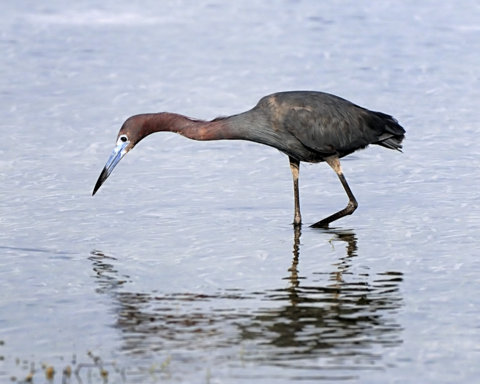
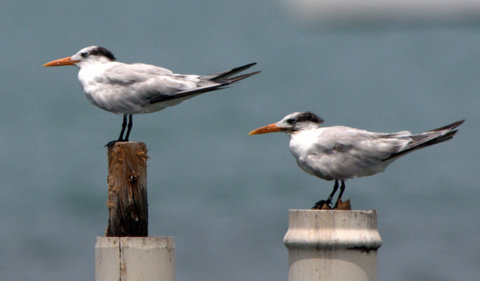
To refresh your memory, here is the photo from June’s Bird Quiz. It was taken in Puerto Rico during the month of May, but you can also see these all along the Gulf coast. Don’t read any further if you want one last chance to identify this bird.
Impressive: White-lined Sphinx Moths
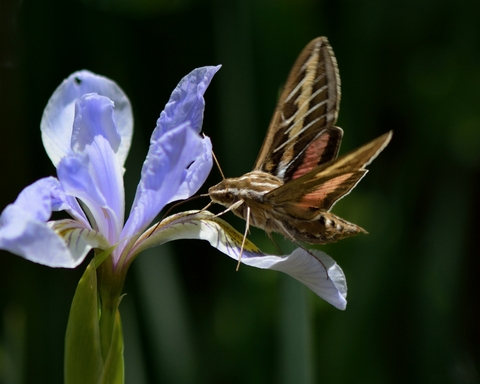 I was happily taking pictures of the flowers at Hudson Gardens last weekend when I noticed a huge moth siphoning nectar from the lilacs nearby. Looking up, I realized that there were dozens of these moths, fluttering around the catmint, hovering in front of the Red Feathers (below), and flocking (what do you call groups of moths, anyway?) around the lilac blooms. I started photographing them instead of the flowers.
June’s Bird Quiz
Can you identify this bird? The photo was taken in Puerto Rico during the month of May. The answer will appear next week.
The Perfect Purple Pea Plant
 I fell in love with Baptisia australis (aka Blue False Indigo) the first time I saw it in full bloom at the Denver Botanic Gardens. Then again, I do have a “thing” for purple flowers (which probably explains the profusion of cat mint, May Queen sage, and Veronica growing in front of our house).
Baptisia is a perennial; the plants die back to the roots after the first freeze. However, come spring the plants quickly grow into attractive mounded shrubs about three to four feet in diameter. If that is too large for your space, there’s a dwarf form that only reaches half that size. (more…)
Shark Valley Birding
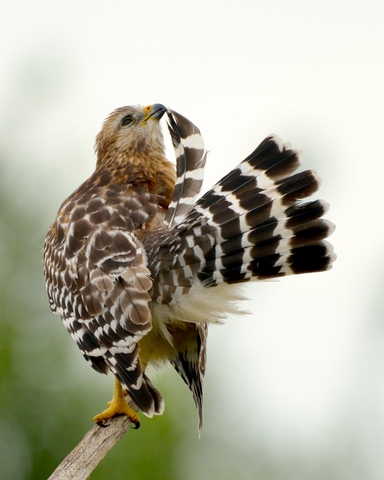 My camera was aimed at a Red-shouldered Hawk perched high in a tree, diligently preening its tail feathers. The angle was awkward—too far and the bird was a mere speck in the picture, too close and I was looking at the bird from below. I slowly backed up, trying to fill the frame and still capture the action. Intent on getting the shot, I stumbled over something behind me, and turned to see what was blocking my way. Oops! I’d tripped over an alligator!
Lucky for me, it was a relatively small alligator, perhaps six or seven feet long, and sound asleep in the warm sunshine. As my adrenalin levels receded, I made a mental note to pay more attention to my surroundings. After all, I was birding in the Everglades!
Gardening with Children: What to Grow (Part 2)
(If you missed it, Part 1 was a few weeks ago.)
When choosing plants for children to grow, remember that kids like to have fun.
 How about flowers that do something? Every child loves to pinch the sides of snapdragon blossoms to make them snap! And Obedient Plant (Physostegia virginiana, left) earns its name because the individual flowers stay how you bend them.
Pole beans can be planted around a bamboo teepee. So can vining flowers such as scarlet runner beans or morning glories. Plant corn in a square with a hidden room in the middle. (Be sure to leave a door opening.) It’s all right if the corn isn’t fully pollinated. The goal isn’t dinner, but rather having fun—and how fun is it to grow your own house?! (more…)
A Profusion of Warblers
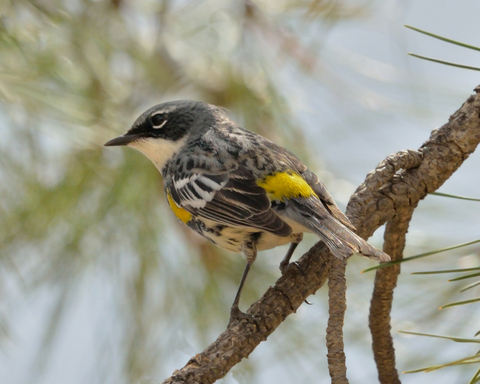 I will always remember this May as the month the warblers came. My Facebook feed is full of sightings. My friends are texting me from the field, wanting to share their excitement. The rare-bird lists are overflowing. It seems that warblers are everywhere.
Living along the Front Range of Colorado, we don’t normally experience quite the same seasonal torrent of these Neotropical migrant as states east of the plains. We can expect to see some species—Yellow, Wilson’s, Common Yellowthroat, perhaps an Orange-crowned, Virginia’s, or Yellow-breasted Chat, and it’s a rare summer field trip that doesn’t turn up plenty of Yellow-rumped Warblers, mostly the yellow-throated Audubon’s subspecies. (The above photo is the white-throated Myrtle’s subspecies, showing off his yellow rump.) We’re too far east (or not desert-y enough) for truly western birds—Black-throated Gray, Townsend’s, Hermit, Grace’s, or MacGillivray’s.
Bugs vs. Bugs
I have a post all ready to go for today, but when a friend shared this news report with me, I just had to share it with you. Be sure to read the comments! This is why we need science education.
Cleaning up with bugs
May Quiz: Answer
To refresh your memory, here is the photo from May’s Bird Quiz. It was taken in Puerto Rico during the month of May. Don’t read any further if you want one last chance to identify these birds.
Mother Love
Sunday is Mother’s Day, so I thought it would be appropriate to celebrate motherhood as seen through my lens.


